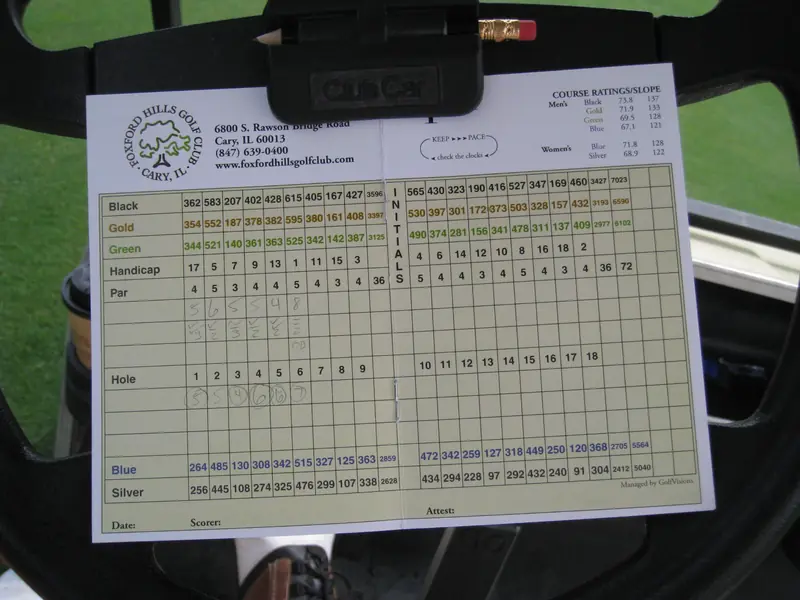
Mini golf has no single governing rulebook that every course follows. Commercial courses post their own house rules, and competitive organisations publish formal regulations, but the version most people play is a handful of shared conventions. Knowing them helps your group play quickly and avoid arguments, whether you are at a seaside course or on a home-made layout in the garden.
The basic flow of a hole
Each player starts from the tee area, usually a mat or marked spot. The aim is to get the ball into the cup in as few strokes as possible. A stroke is any deliberate attempt to hit the ball, including a miss. Players take turns, and each stroke counts toward that hole's score.
On many courses, everyone putts once from the tee, then the player whose ball is furthest from the cup goes next. This mirrors regular golf and stops players from standing in each other's lines. For casual groups, a simpler approach is for each player to finish the hole before the next person starts. That is faster when the course is busy and much easier with young children.
Common rules you will meet
- Stroke limit. Many courses cap each hole at a set number, often six or seven strokes. If you have not holed out by then, you record the maximum and move on. This keeps the queue moving.
- Out of bounds. If the ball leaves the playing surface, it is usually placed back where it went out, or at the tee, with a one-stroke penalty.
- Ball against a wall. Many house rules allow you to move a ball that is resting against a border, typically about one putter-head length away, without penalty.
- Obstacles. If a ball gets stuck inside a windmill or tunnel, the usual fix is to place it at the exit.
- Hazards. Water features and sand traps usually cost a stroke, with the ball placed at a marked drop spot.
- Hitting a moving ball. Wait for the ball to stop before your next stroke. Hitting a moving ball is generally not allowed.
Always check the signboard at the first tee. Posted rules take priority over anything your group has agreed.
Keeping score
The scorecard lists each hole with a par, which is the number of strokes a good player is expected to need. Write down each player's strokes per hole and add them at the end. Lowest total wins.
| Hole | Par | Sam | Priya | Leo |
|---|---|---|---|---|
| 1 | 2 | 2 | 3 | 1 |
| 2 | 3 | 4 | 3 | 6 (max) |
| 3 | 2 | 2 | 2 | 3 |
| Total | 7 | 8 | 8 | 10 |
Some groups track scores relative to par ("one over", "two under") because it is easier to see who is doing well halfway through the round. A hole-in-one, also called an ace, is a single stroke from the tee. Many commercial courses have a bonus hole at the end where an ace earns a small prize.
Breaking ties
Ties are common in mini golf because the totals are small. Agree how to break them before you start. Popular options:
- Sudden death. Replay the last hole (or any agreed hole) until one player wins it.
- Most aces. The player with more holes-in-one wins.
- Countback. Compare scores on the last three holes, then the last six, until someone is ahead.
- Closest to the cup. Each player takes one putt from the tee of a chosen hole; nearest ball wins.
Etiquette that makes everyone's round better
Good manners in mini golf are mostly about time and space. Stand out of the putting line and behind the player who is putting. Stay quiet while someone is lining up, at least on the "serious" holes. Pick up your ball after holing out so the next player has a clear cup.
On a busy public course, keep pace with the group ahead. If a faster group is waiting behind you, let them play through at a natural gap. Do not climb on obstacles or lean on walls, and never swing a putter like a full golf club. Mini golf putters are for putting, and full swings are how balls end up in the car park.
At home, etiquette is more relaxed, but a couple of habits still help. Appoint one scorekeeper so the numbers are consistent, and settle rule questions at the tee rather than halfway through a disputed putt.
House rules worth adopting
Once the basics are clear, a few extra house rules can make things more inclusive. Let younger kids tee off from a spot closer to the cup. Give first-timers one free "mulligan", a do-over stroke, per round. Or adopt a lower stroke limit for everyone so nobody spends ten shots on one hole. For more ways to shake things up, see our list of mini golf party games.
Frequently asked questions
What is par in mini golf?
Par is the number of strokes a skilled player should need on a hole. Most mini golf holes are par 2, 3 or 4, and an 18-hole course often totals somewhere in the 40s to 50s, depending on design.
Can you move your ball if it is against the wall?
Many courses allow it, usually about one putter-head length away from the wall, without penalty. Check the posted rules because some courses require you to play it as it lies.
What happens if my ball goes into the water?
Typically you take a one-stroke penalty and place the ball at the marked drop area or where it entered the hazard.
Is it rude to putt out of turn?
On a quiet casual round it is fine if everyone agrees. On a busy course, following a consistent order keeps players safe and the round moving.
Play safe: swing low near people, pets and windows, and follow any posted course rules.